Search for answers or browse our knowledge base.
-
Behaviour Scoring
-
- 1. Anxious in unfamiliar situations
- 2. Fear Of Noises
- 3. Fear of Novel Objects
- 4. Fear of Underfootings
- 5. Fear of Dogs
- 6. Fear of Stairs
- 7. Fear of Traffic
- 8. Separation Anxiety
- 9. Hyper-Attachment
- 10. Fear Of Strangers
- 11. Body Handling Concern
- 12. Retreats When Reached For
- 13. Harness Handle On Back Sensitivity
- 14. Avoidance Of Blowing Fan
- 15. Body Sensitivity To Object Contact
- 16. Anxious About Riding In Vehicles
- 17. Inhibited or passively avoidant when exposed to potentially stressful situations
- 18. Activated when exposed to potentially stressful situations
- 19. Excitable
- 20. Slow To Return To Productive Emotional State
- 21. Fidgety When Handler Is Idle
- 22. Fear On Elevated Areas, Drop-Offs Etc.
- 23. Barks Persistently
- 24. High Energy Level
- 25. Lacks Focus
- 26. Movement Excites
- 27. Chasing Animals
- 28. Dog Distraction
- 29. Sniffing
- 30. Scavenges
- 31. Inappropriate Behavior Around The Home
- 32. Lacks Initiative
- 33. Not Willing
- 34. Resource Guarding Toward People
- 35. Aggression Toward Strangers
- 36. Aggression Toward Dogs
- 37. Resource Guarding Toward Dogs Or Other Pets
- 38. Inappropriate Elimination While Working En Route
- 39. Socially Inappropriate Behavior With People
- 40. Inconsistent
- 41. Handler/Dog Team
- 42. Relationship Skills
- 43. Comparison 9 To 1 Score
- 44. Socially Inappropriate Behavior With Dogs
- 45. Thunder Reaction Prior To, During Or Immediately After A Thunderstorm
- 46. Kennels Poorly
- 47. Working Speed
- 48. Gait When Moving Out
- 49. Housebreaking Problems
- 50. Innate Desire To Work
- 51. Avoidance Of Exhaust From Vehicles
- Show all articles ( 36 ) Collapse Articles
-
-
-
Practice Videos
-
Behavior Testing
-
Database User Manual
-
-
-
- Adding a New Dog (using Manage Your Dog’s Data, MyDogs)
- Alerts
- BCL, Behavior Checklist
- Elbow Quick, Add new
- Estrus & Whelps
- Eye Quick
- Genetic Test Panel
- Genetic Test Quick
- Health Diagnoses Add/Edit
- Health History Report
- Health Normals, Add new
- Heart Quick
- Hip BVA, Add new
- Hip FCI, Add new
- Hip OFA, Add new
- Hip Penn Hip, Add new
- Photos PDFs etc.
- Private Notes
- Procedures, Add new
- Reminders
- Share my dog data to another organization
- Skin Quick
- Status History
- Weight - Entering a dog's weight
- ADI Public Access Test
- Hip Vezzoni, Add new
- Status Detail
- Edit or Change Call Name / Pedigree Name / Owner ID
- Add New Microchip / Delete Incorrect Microchip
- End Reasons
- Juvenile Estrus
- Communications Activities
- Incidents
- Creating Dog Records - What to Enter
- Creating Dog Records - Budgeting Time for Data Entry
- My Dogs Overview
- My Dogs Tabs Overview
- Show all articles ( 22 ) Collapse Articles
-
- Articles coming soon
-
-
-
-
- Alternate Therapy/Rehab
- Diagnostic Imaging, Add new / Edit or Delete
- Diet
- Elbow Quick, Add new / Edit or Delete
- Estrus & Whelps, Add new
- Eye Quick, Add new / Edit or Delete
- Genetic Test Quick, Add new / Edit or Delete
- Health Diagnoses, Add new / Edit (Update) or Delete
- Health History Report, Generate a PDF
- Health Normals
- Health Screening List
- Hip OFA Add new / Edit or Delete
- Hip Penn Hip Add new / Edit or Delete
- Hospitalization, Add new
- Kennel Tasks, Add new / Edit or Delete
- Lab, Add new / Edit or Delete
- Photos, PDFs, etc., Add new
- Reminders Add new / Edit or Delete
- Rx, Add new / Edit or Delete
- Semen Cryo, Add new / Edit or Delete
- Skin Quick Add new / Edit or Delete
- SOAP, Add new / Edit or Delete
- Status History
- Supplies Used, Add new / Edit or Delete
- Surgery, Add new
- Treatments Add new / Edit or Delete
- Vaccines Add new / Edit or Delete
- Weight and BCS Body Condition Score - Add new / Edit or Delete
- Hip Vezzoni, Add new
- Show all articles ( 14 ) Collapse Articles
-
-
-
- Client Services - Client Basic Info/ Add & Edit
- Edit Application
- Manage Team Training
- Active Graduated Team
- Chart Active Dogs By Age
- Facility Basic Info
- Active Facility Dogs
- Client Program Types and Training locations
- Order of Entry for Client Records
- Creating Client Records
- Facility Dog Applications
- Placing Dogs with Clients and Graduating Teams
-
- About People/Organizations
- Relationships
- Breeders List
- My People
- Public People & Orgs
- Updating a Dog's Foster Carer / Puppy Raiser / Breeding Host
- Managing Puppy Raiser and Breeder Host applications
- Entering Private People & Organizations
- Entering Public People and Organizations
- Foster Carer Application and Management
- Releasing Retired Dogs / Placing with Adopters
-
- Setting up your Administrator Account
- Adding More Users
- Changing User Permissions and Removing Users
- Managing List Customizations
- Customizing Regions
- Understanding the All Dogs page
- Using Searches and Reports
- Client Program Types and Training locations
- Order of Entry for Client Records
- Creating Client Records
- Facility Dog Applications
- Placing Dogs with Clients and Graduating Teams
- Creating Dog Records - What to Enter
- Creating Dog Records - Budgeting Time for Data Entry
- My Dogs Overview
- Preparing to Enter Foundation Breeders and Ancestors
- Claiming Records of Your Dogs Already in IWDR
- Adding Foundation/Ancestor Records
- Adding Foundation/My Dog Records
- Health Clearances for Foundation Breeders
- My Dogs Tabs Overview
- Entering Private People & Organizations
- Entering Public People and Organizations
- Creating Litter Records
- Overview of Estrus and Breeding
- Entering Juvenile Estrus/Puppy Heats
- Litter Tracking
- Breeder Host and Care
- Vet Care
- Foster Carer Application and Management
- Releasing Retired Dogs / Placing with Adopters
- Show all articles ( 16 ) Collapse Articles
-
-
Early Socialization
-
- Video - Coat Desensitization
- Video - Novel Objects
- Video - Trolley Ride with Mom
- Early Puppy Socialization - Novel Objects video
- Early Puppy Socialization – Novel Sounds video
- Early Puppy Socialization – Introducing New Environments video
- Early Puppy Socialization – Motor Development, Balance, Coordination, Proprioception video
- Early Puppy Socialization – Passive Environmental Enrichment in the Den video
- Early Puppy Socialization – Stairs
-
-
Genetic Selection & Inbreeding
-
- What are EBVs and how do they help?
- How EBVs are calculated
- What is needed to calculate EBVs and EBV accuracy?
- Using EBVs effectively
- Selection index
- Why are EBVs different for littermates?
- Presentation Recording: Improving behavior using EBVs
- Presentation Recording: Using EBVs successfully
- Presentation Recording - Improving health using EBVs
-
Webinars
-
Reproduction
-
Organization Management
Weight – Entering a dog’s weight
0 out of 5 stars
| 5 Stars | 0% | |
| 4 Stars | 0% | |
| 3 Stars | 0% | |
| 2 Stars | 0% | |
| 1 Stars | 0% |
To begin, follow steps on searching /selecting the dog with which you would like to add/edit their file.
Once selected, follow these steps…
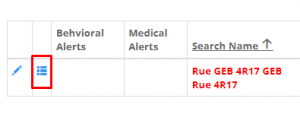
1. Select the [Show Details] icon to the left of the dog’s name.
![]()
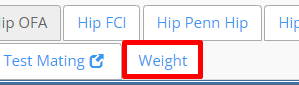
2. Select [Weight] from the menu tabs.
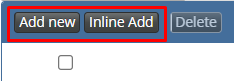
3. Select [Add new] or [Inline Add]
4. Enter the fields below. A, B, and F are required fields.
A. *What Was Done – Select an option from the drop down menu of what type of weight was done (Weight Birth, Weight routine adult, etc.)
B. *Date – Enter the date the Weight was taken.
C. Weight kg or Weight Lb – Enter the weight in either kg or lbs (If you enter in kg, the other field will auto fill with pounds, and if you enter in pounds, the other field will auto fill with Kg)
D. Normal – Enter Yes or No from the drop-down window
E. Notes – Here you can add any additional information / details you wish.
F. *Days Due Again – Enter the number of days the next weight check is due. This will generate an automatic Reminder. If not necessary to have a reminder, leave at 0.
G. Once all required data is entered, click [Save] button at bottom of screen.
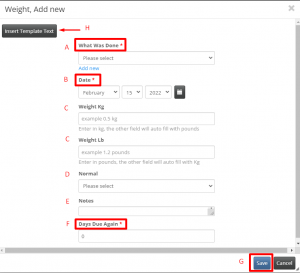
H. There is an option to [Insert Template Text]. Please see separate instructions on how to do this as they need to be created prior to using.
5. Now your weights will appear in the list on the main Weights page.
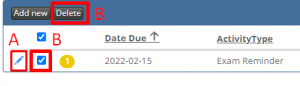
6. You can edit or delete a weight from the list
A. Edit by selecting the [Edit] icon (pencil) – the fields shown in #4 will appear. Edit what needs to be edited, and click [Save] when finished.
B. Delete by clicking on the box to left in the row you wish to delete. This will activate the [Delete] button.
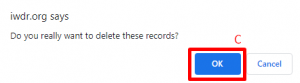
C. Click on [Delete] and confirm on the pop-up window by clicking [OK].
7. Body Condition – After adding a weight to the file, you can now score its Body Condition for this weight.
Body condition scoring is considered the pet version of the BMI (Body Mass Index). It is a management tool designed to assess body reserves or fat accumulation of an animal.
The most common scale to score a Canine Body Condition is a score range from one (1) to nine (9) with one being assigned to an extremely skinny or emaciated animal, and a score of nine assigned to an extremely obese animal.
- Some practices follow a 5 point scale with again one being very thin and five being Obese.
It is good practice to keep a body condition score on each dog so you can track any fluctuation between examinations.
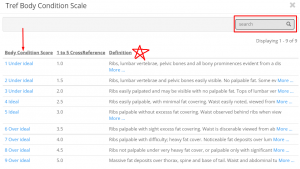
You can select and record body condition using the Body Condition Scale as follows.
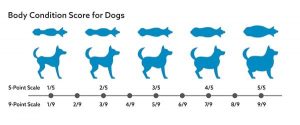
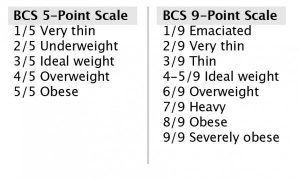
In IWDR it will list the scale based on the nine point scale.
-
-
- Under ideal – Ribs, lumbar vertebrae, pelvic bones and all bony prominences evident from a distance. No discernible body fat. Obvious loss of muscle mass.
- Under ideal – Ribs, lumbar vertebrae and pelvic bones easily visible. No palpable fat. Some evidence of other bony prominences. Minimal loss of muscle mass.
- Under ideal – Ribs easily palpated and may be visible with no palpable fat. Tops of lumbar vertebrae visible. Pelvic bones becoming prominent. Obvious waist and abdominal tuck.
- Ideal – Ribs easily palpable, with minimal fat covering. Waist easily noted, viewed from above. Abdominal tuck evident.
- Ideal – Ribs palpable without excess fat covering. Waist observed behind ribs when viewed from above. Abdomen tucked up when viewed from side.
- Over ideal – Ribs palpable with sight excess fat covering. Waist is discernable viewed from above but is not prominent. Abdominal tuck apparent.
- Over ideal – Ribs palpable with difficulty; heavy fat cover. Noticeable fat deposits over lumbar area and base of tail. Waist absent or barely visible. Abdominal tuck may be present.
- Over ideal – Ribs not palpable under very heavy fat cover, or palpable only with significant pressure. Heavy fat deposits over lumbar area and base of tail. Waist absent. No abdominal tuck. Obvious abdominal distention may be present.
- Over ideal – Massive fat deposits over thorax, spine and base of tail. Waist and abdominal tuck absent. Fat deposits on neck and limbs. Obvious abdominal distention.
-
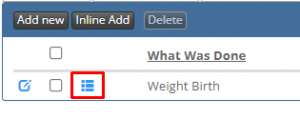
8. In the row of the weight you just entered and wish to add a BCS to, select the [Show Details] icon/table.
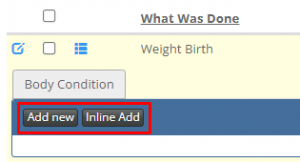
9. Click on [Add new] for a pop up window or [Inline Add] for viewing/adding in a row below the Inline Add button.
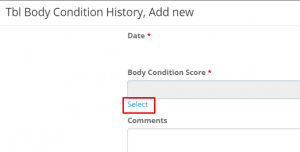
10. With either option, you will need to [Select] the BCS from the menu. Enter the number/score in the [search] field or click on the option from the list and click the [Search] button (magnifying glass).
The 1 to 5 Cross Reference and the definitions are also listed in the corresponding row to help with your selection.
11. Click [Save] at the bottom of the page. ![]()

12. The BCS will then be listed in the Body Condition tab, as well you can see the current / last recorded BCS on the dog’s main file page.
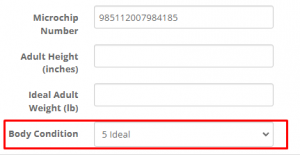
13. You can also add the Body condition score directly to the dog’s main file page by selecting the score from the drop-down menu.
0 out of 5 stars
| 5 Stars | 0% | |
| 4 Stars | 0% | |
| 3 Stars | 0% | |
| 2 Stars | 0% | |
| 1 Stars | 0% |